
Exploring Life Beyond What We Already Know
An independent approach to human experience, individual uniqueness, scientific knowledge and unexplored possibilities.
Why I developed the DNA Programme™
Since 2006, I have been developing the DNA Programme™ around a question that has accompanied me throughout my life:
Why do we do what we do?
The more I explored human development, psychology, natural sciences, cultural traditions and my own experiences, the more I recognised how complex that question really is.
We share biological processes, environmental influences and fundamental needs. Yet no two individuals experience life from precisely the same position.
Each of us develops through a unique combination of circumstances, relationships, experiences, interpretations and possibilities.
And that uniqueness is central to my work.
The DNA Programme™ is my interpretation of life’s dynamic configurations — an evolving framework for exploring how we experience, understand, interact with and contribute to the world around us.
It is not a formula claiming to explain everything about life. Nor is it an alternative to established scientific knowledge.
It invites us to explore life through different perspectives, question assumptions, recognise possibilities, and become more aware of our role in what happens next.

Three perspectives. One living system.
At the heart of the DNA Programme™ are three interconnected perspectives:
Within — Our individual and unique experience
What happens within us? How do our bodies, sensations, feelings, emotions, memories, and interpretations shape our experience of being alive?
Between — How we interact with the world around us
What happens when our inner experience meets the world around us, here (in space) and now (in time)? Our relationships, societies, cultures, natural environments and the wider universe shape what we experience, understand and become. Through our choices and actions, we also influence other people and the places we share.
Without me — What my presence sets in motion
What carries on in the world without me there? Something I said may shape a decision, an action may change a place, or an encounter may stay with someone and affect how they feel. These effects can begin while I am present and continue long after I leave, or even after I die. Some are deliberate. Others unfold without my knowing what I set in motion.
Together, these perspectives help me observe what happens within me, what happens between us, and what continues without me.

From the three perspectives to Dynamic Energy
I’ve often wondered whether one of life’s hardest lessons is learning to be without.
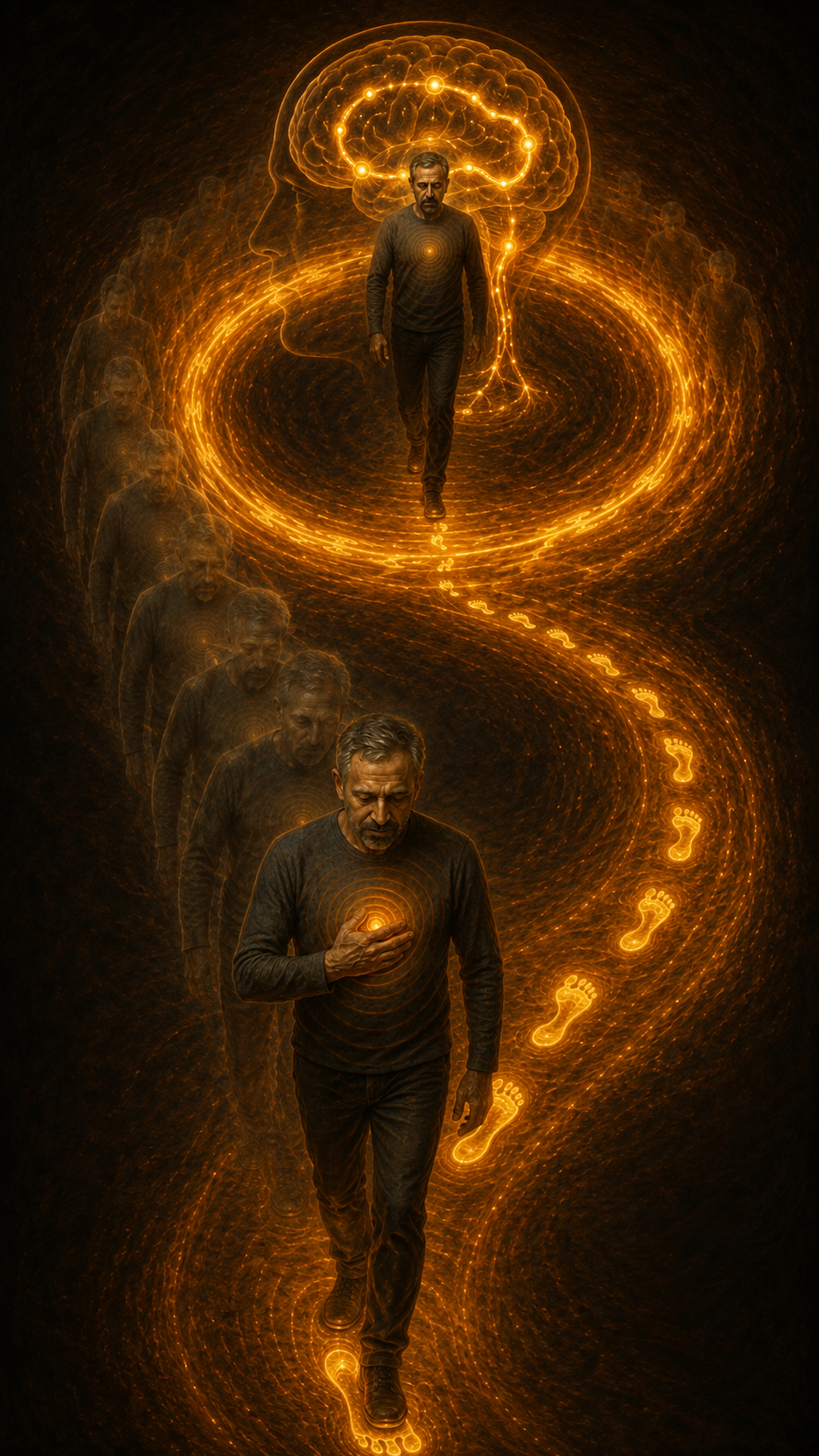
The three perspectives began to take shape when I started paying attention to what happened Within me: how I thought, how my body responded to sensations, and how I experienced feelings and emotions. Then I began to notice what happened Between me and the world around me. How I expressed what I felt shaped my relationships, and those relationships showed me ways of seeing life that I hadn’t considered before.
Then came Without. I lost money. Relationships came, changed and ended. I could go from feeling well and happy to facing a life-or-death situation within minutes. Each of those experiences forced me to ask what it meant to let go.
I can see how something of me might continue in the lives of people I’ve known. I also wonder whether anything of my own experience could continue beyond my death, perhaps in some form of energy. I began to explore what we mean by human energy and whether the question pointed to a real possibility or gave shape to something I couldn’t yet answer.
That exploration became the starting point for Dynamic Energy, my first book. The ideas I began developing there grew into the DNA Programme™ and the projects through which I continue to explore them today.
I still return to the hardest question. What does it mean to let go at the point of death? What happens when we have to let go of our bodies, what we’ve gathered, everything we’ve done to become who we are, and perhaps even consciousness itself? Could the idea of human energy help me understand how these three perspectives connect, and what, if anything, carries on?
Exploring what we know — and what we do not
Scientific research has transformed our understanding of life. Yet knowledge continues to develop, and many questions remain unresolved.
I believe there is value in examining not only established explanations but also the possibilities, contradictions and experiences that challenge our current understanding.
My interests span psychology, neuroscience, biology, physics, cosmology, philosophy, ancient traditions, and cultural interpretations of existence.
They also include questions about consciousness, spirituality, souls, the afterlife, extraterrestrial life, other dimensions and the nature of the universe itself.
Exploring these subjects does not mean accepting every claim, defending a particular belief or suggesting that all explanations are equally supported by evidence.
It means recognising the difference between what we know, what we believe, what we experience, what we hypothesise and what remains unknown.
These distinctions let us explore unfamiliar perspectives without abandoning critical thinking.
I am interested in the questions that emerge when different forms of knowledge and interpretation meet.
What might we discover by examining what we do not yet understand?
And could some of our assumptions be limiting the questions we are willing to ask?

The importance of individual uniqueness
Science often investigates patterns across populations, providing valuable insights into how individuals and systems function.
But population-level patterns do not describe every aspect of every individual’s experience.
An average can reveal something important about a group while leaving meaningful differences between individuals unexplained.
This is not a failure of science. It reminds us that different questions require different approaches.
I am particularly interested in what we might learn from individual variation, unusual responses, overlooked experiences and observations that existing explanations do not fully account for.
What can the exception teach us about the pattern?
Within the DNA Programme™, uniqueness is not something to overcome to achieve uniformity. It is a fundamental aspect of how I interpret life’s diversity, interactions and potential for development.
We cannot experience another person’s life exactly as they do. But we can listen, observe, communicate, compare perspectives and develop greater understanding.
Our differences do not have to create division.
They can expand what we learn from one another and create possibilities none of us might have recognised on our own.

How I explore and share these ideas
My articles and investigations generally develop through three interconnected stages.
1. Personal experience — An invitation to reflect
I begin with an observation, question, contradiction or experience from my own life.
This is where I can express my experiences openly, without the need to justify them as right or wrong. They are my interpretations of life, shaped by my unique perspective, not judgements or universal truths.
By sharing them, I invite readers to explore their own experiences, recognise differences and consider perspectives they may not have encountered before. We don't need to experience life the same way to learn from one another. Our differences can expand our understanding and reveal new possibilities.
Have I experienced something similar? How did I understand it? Could there be another explanation?
2. The DNA Programme™ — Exploring different perspectives
I then examine the experience through my developing concepts, interpretations and theoretical models.
Some ideas connect with established knowledge. Others are provisional, speculative or require further investigation.
The intention is not to provide a final answer, but to explore possible relationships, mechanisms and meanings, including those that conventional explanations may not fully address.
3. Scientific research — Evidence, comparison and further questions
Finally, I examine relevant scientific findings, theoretical debates and research limitations.
Where do the findings agree with my interpretation? Where do they differ? What remains uncertain? And what might be investigated further?
I use scientific evidence to examine specific claims within the DNA Programme™ and to revise or abandon them when the evidence warrants it.
The objective is to help readers consider different perspectives, evaluate the available evidence, and develop their own informed interpretations.

An evolving investigation, not a conclusion
I don't assume every idea I develop will prove useful or accurate.
Some interpretations may gain support through further research. Others may require revision, and some may eventually need to be abandoned.
That is part of the exploration.
I want the DNA Programme™ to remain open to questioning, disagreement, discovery and change, including challenges to my own conclusions.
Because developing understanding requires more than defending what we already believe.
It requires recognising what we might have overlooked.

What I hope to achieve
I aim to encourage a more thoughtful relationship with ourselves, other people and the world we share.
To strengthen awareness without demanding agreement.
To encourage curiosity without abandoning critical judgement.
To recognise individuality without creating isolation.
To explore differences without automatically turning them into conflicts.
And to investigate possibilities without presenting speculation as certainty.
Above all, I want to develop a framework through which people can recognise how their experiences, choices and interactions contribute to their own development and influence the possibilities available to others.
We may never fully understand every dimension of life. But we can continue expanding how we observe, question, interpret and participate in it.
That is the continuing purpose of my work and the DNA Programme™.
Life is dynamic. Find your rhythm. Develop your contribution.

Explore the DNA Programme™ in Practice
Through my articles, I invite you to explore personal experiences, consider original interpretations and examine scientific research from different perspectives.
You do not need to agree with my conclusions.
I invite you to question them, compare them with your own experiences, and discover what new possibilities they might open.

An open invitation to question and collaborate
I do not assume that I have examined every available study, theory or perspective relevant to the subjects I explore. My interpretations and conclusions reflect the knowledge, research and experiences I have considered so far.
I may have overlooked evidence, alternative explanations worth investigating, or discoveries that challenge or expand my understanding.
If you are aware of relevant research, have a different perspective or identify something that deserves further examination, I welcome your contribution.
Whether you are a researcher, professional, student, or simply someone interested in these questions, I invite you to share your insights, challenge my interpretations, and explore opportunities for collaboration.
My intention is not to defend every conclusion, but to keep refining the DNA Programme™, its articles, and its developing framework through constructive dialogue, critical thinking, and shared discovery.
Understanding expands when we remain willing to learn from one another.
